PLEXUS · VENTURE LABS
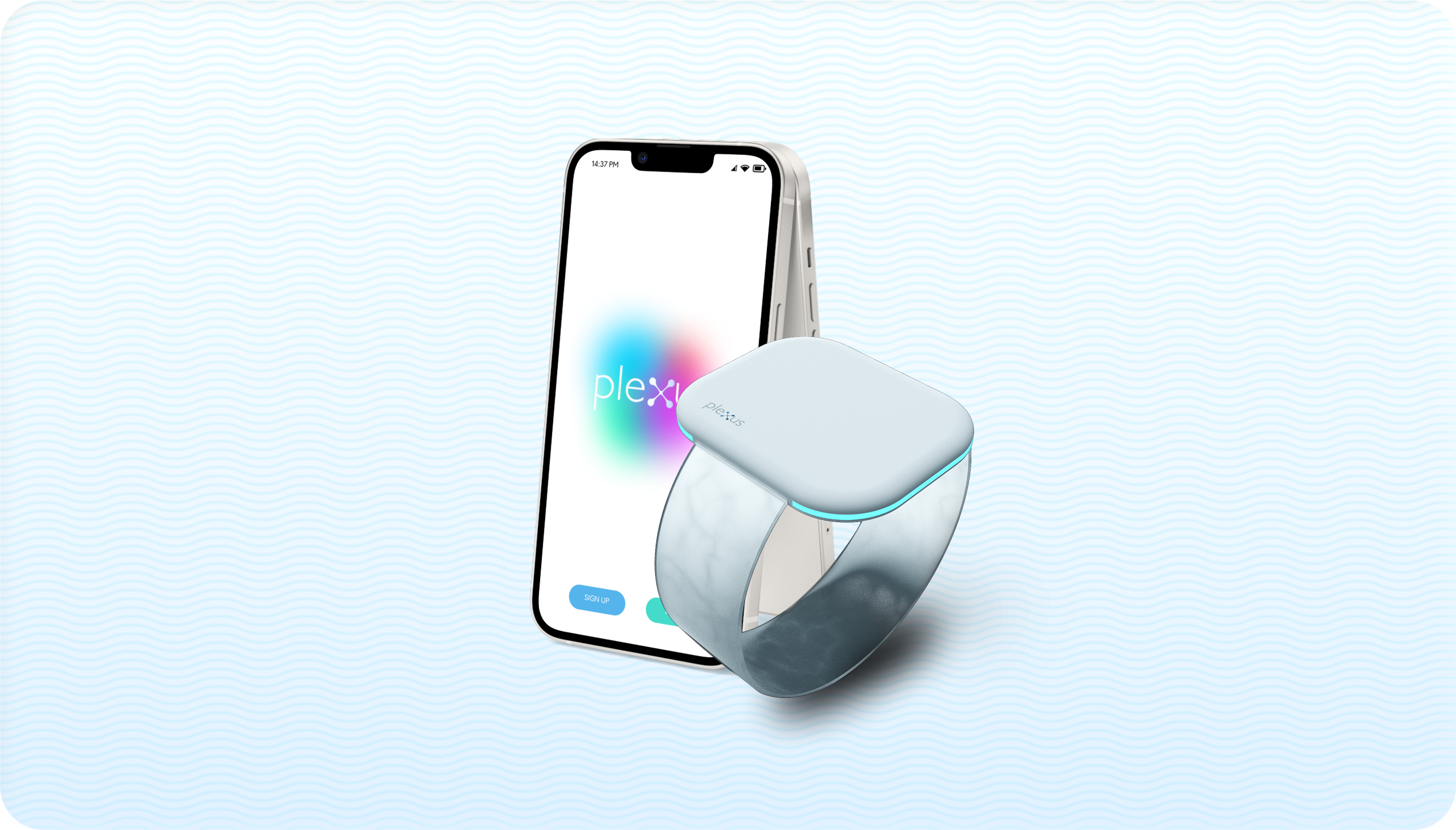
Plexus device
Company
Venture Labs
Role
Systems Designer, Product Designer, Industrial Designer
Tools & Skills
Rhino 3D, Procreate, Keyshot · UI/UX Design, Systems Design
Team
Product Manager, Venture Builder, Physicians
Time Frame
4 weeks

A wearable for managing
hypertension, silently.

A medical wearable and connected mobile ecosystem for passive blood pressure monitoring — designed for the 1 in 3 Americans living with hypertension.

01 — The Problem

1 in 3 Americans have hypertension. Most of them don't know it.

Hypertension is a silent chronic condition — symptoms don't appear until severe. Without continuous monitoring, neither patients nor physicians can understand patterns or prevent crises.

~1,000
Deaths per day in the US alone due to hypertension-related causes
1 in 3
Americans have hypertension — and nearly a third of those don't know it
$51B
Annual estimated cost associated with hypertension treatment in the US
02 — The Opportunity

How might we enable passive monitoring without adding friction?

Managing chronic hypertension demands constant vigilance — daily measurements, medication adherence, and coordination with a care network. Today's tools make all of this harder than it needs to be.

How might we

Create a solution that continuously monitors blood pressure while keeping patients connected to their care network — without disrupting daily life?

03 — The Solution

A wearable + mobile ecosystem.

// 01

Continuous passive monitoring

Plexus monitors blood pressure around the clock using optical and oscillometric sensing — no button presses, no interruptions.

Continuous passive monitoring
// 02

Connected care network

The companion app links patient, family, and physician in one shared view — enabling real-time awareness and proactive intervention.

// 03

Automated diagnosis

Pattern recognition across time surfaces clinically meaningful insights — identifying trends before they become emergencies.

Automated diagnosis
Physical Design

Plexus Device

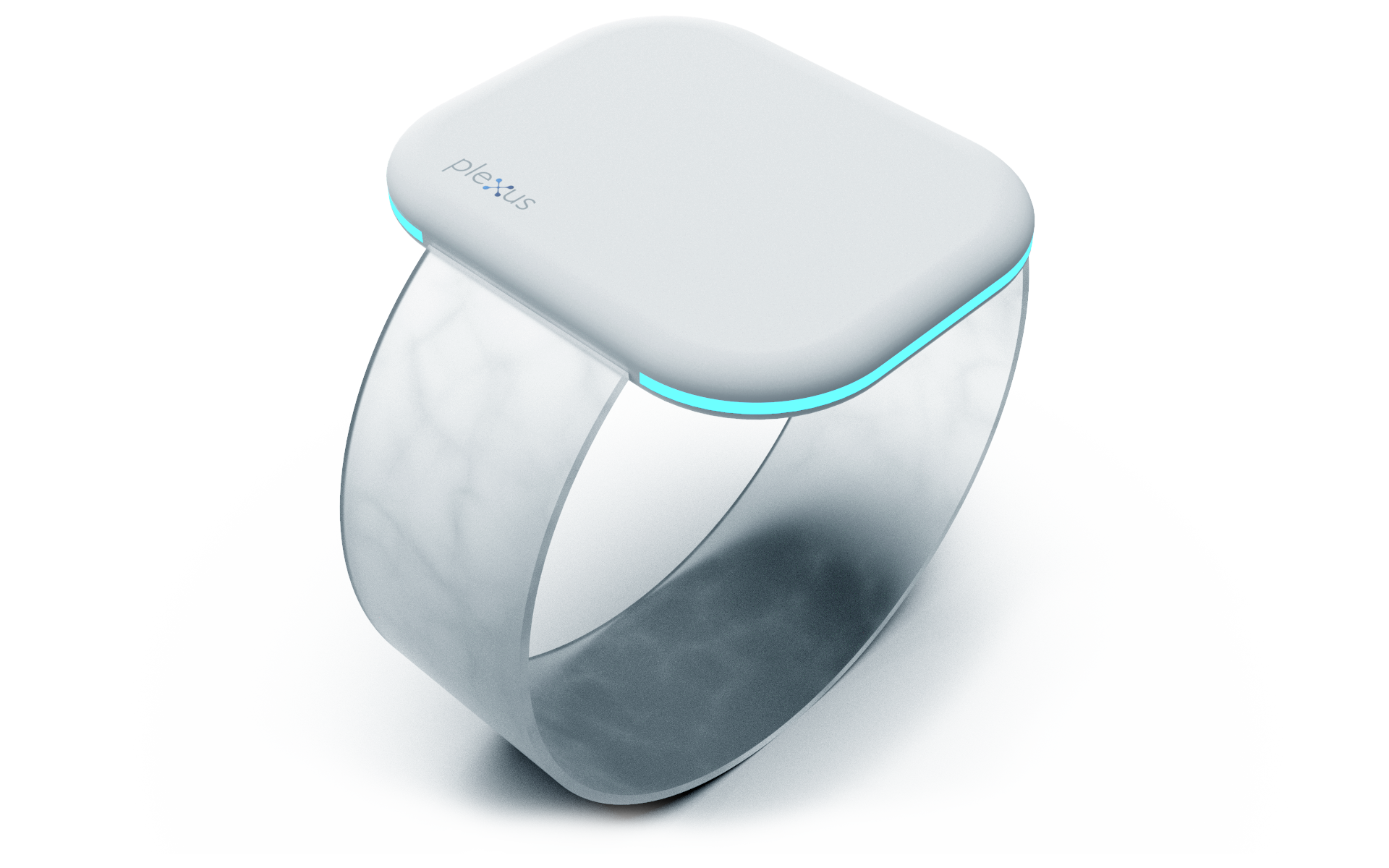
Designed to disappear into daily life. Worn on the wrist, the device features an LED channel that gives ambient feedback on blood pressure stages, battery levels, and device status — without demanding attention.

The Device

Device — Normal BP
Normal BP
Device — bottom view
Bottom view
Device — elevated bp
Green LED flashes
Normal BP Stage< 120/80 mmHg
Device — sTAGE 1 bp
Yellow LED flashes
Elevated BP Stage120/80 – 129/80 mmHg
Orange LED flashes
Orange LED flashes
Stage 1 BP130/80 – 139/89 mmHg
Red LED flashes
Red LED flashes
Stage 2 BP> 140/89 mmHg
04 — User Research

Three personas. One chronic condition.

Qualitative research with patients, caregivers, and physicians surfaced distinct user archetypes — each with a different relationship to their illness, their care network, and technology.

Matt Li · 48 · Chief Technical Officer
"

My work hampers with daily life, adds stress to my lifestyle.

Matt Li · 48 · Chief Technical Officer
Sugandh · 59 · Housewife
"

With my kids in other cities, I feel alone and fear for my hypertension, stresses me out.

Sugandh · 59 · Housewife
Kate · 73 · Housewife
"

Since I have aged, my health problems have increased and act on my irregular blood pressure.

Kate · 73 · Housewife
06 — Journey Map

Journey Map

Mapped from patient interviews, a single day reveals more than routine — it reveals pressure. Ordinary moments carry invisible physiological weight. And when life adds disruption — a pandemic, sudden illness, an unexpected stressor — the condition doesn't gradually worsen. It compounds.

Journey Map
05 — Key Insights

Three critical gaps in hypertension management.

Research with patients and physicians revealed consistent barriers — spanning monitoring, communication, and behavior change.

// 01

Monitoring

Blood pressure changes rapidly and needs 24/7 tracking for physicians to understand patterns — current tools require manual effort and create gaps.

// 02

Care Network

Added life events — stress, pandemic, isolation — demand faster, easier communication between patient and care network that today's tools can't provide.

// 03

Lifestyle

Chronic illness demands sustained behavior change, not just medication. Tools to meaningfully support healthy habits and close the loop with physicians are largely absent.

User Goals

What patients are looking for.

The research and interviews helped me understand what exactly patients are looking for to improve their battle with this chronic illness.

Connect with Your Caregiving Network
Improve Lifestyle Habits
Quick, Easy Communication with PCP
Accurate & Continuous Blood Pressure Monitoring
Better Healthcare Management System
07 — Ecosystem

Plexus Ecosystem.

A closed feedback loop — device monitors, app surfaces insights, care network stays informed, physician acts proactively. Chronic care without chronic friction.
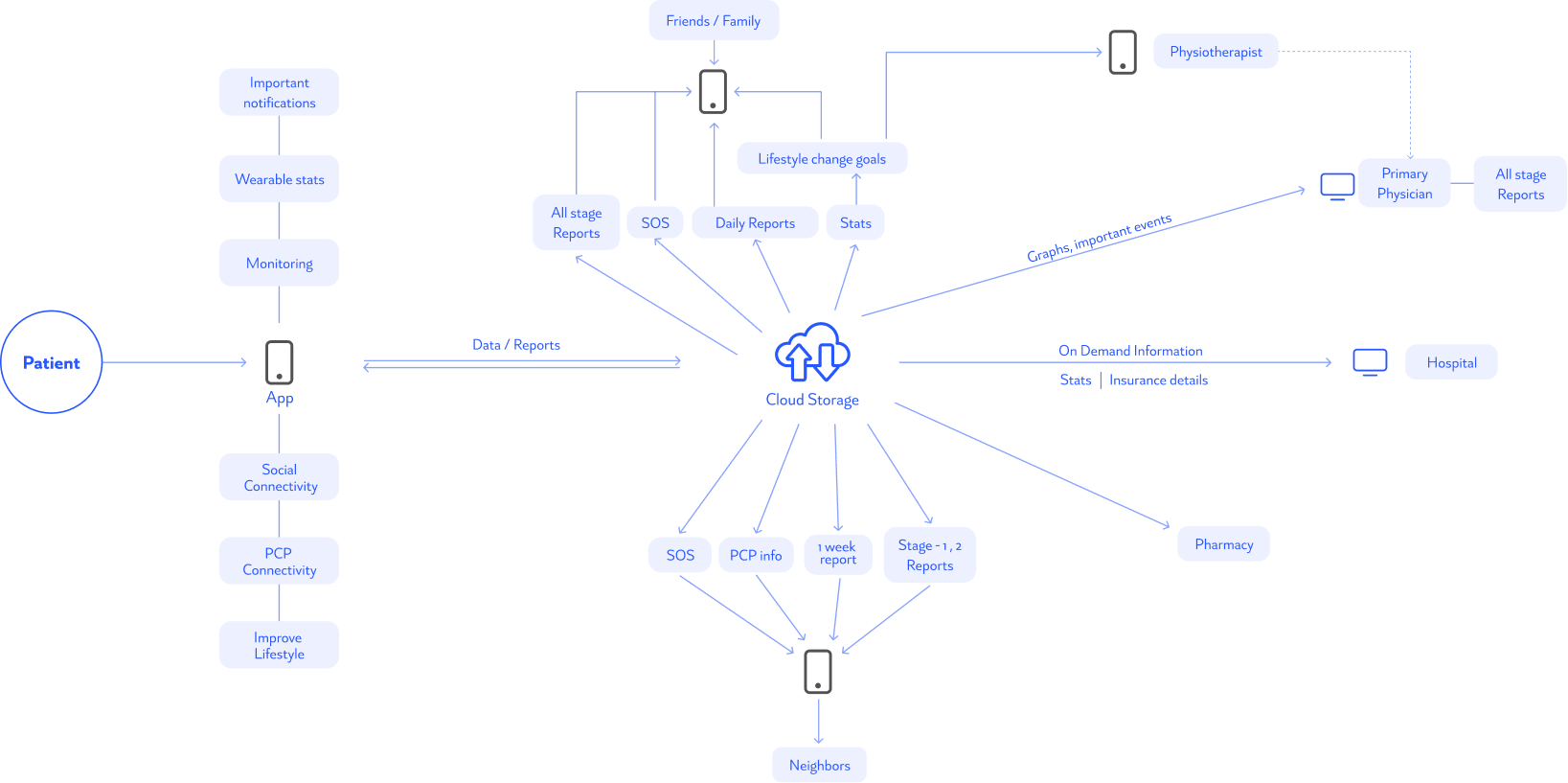
Plexus Ecosystem.
08 — Information Architecture

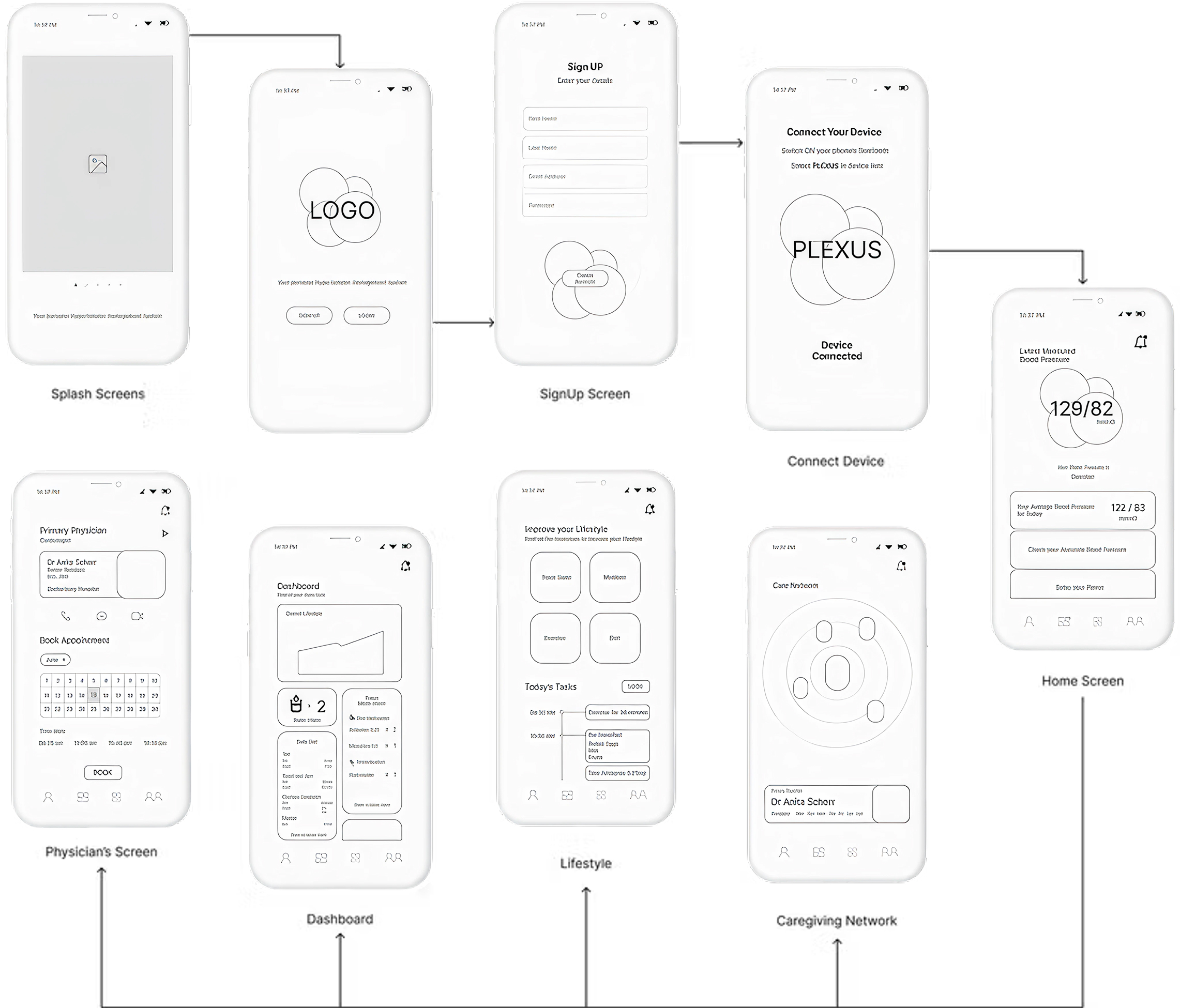
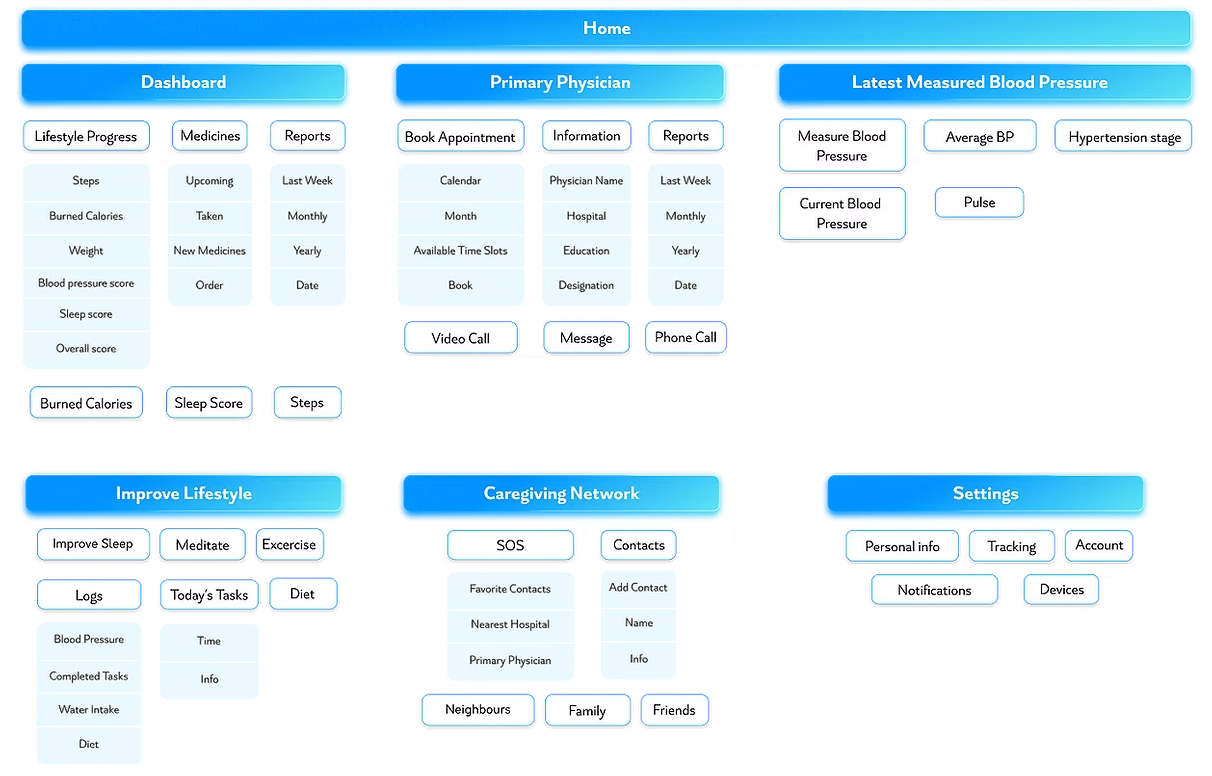
Mapping the patient journey from monitoring to care.

Mapping the patient journey from monitoring to care.
09 — Userflow

From daily measurement to physician alert.

From daily measurement to physician alert.
10 — Final Screens

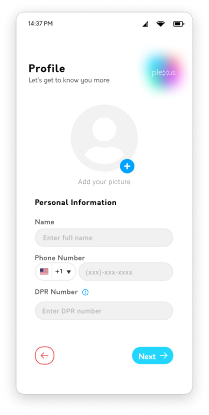
Designed for everyday life.

App screen 1
App screen 2
App screen 4
App screen 5
App screen 6
App screen 7
App screen 8
App screen 9
App screen 10
App screen 11
App screen 12
App screen 13
App screen 14
11 — Learnings

What this project taught us.

Learnings
01
Lifestyle over medication
Managing a chronic illness is not just about taking medication on time — a sustained healthy lifestyle is essential to truly controlling and eradicating it.
02
Early intervention matters
Chronic illness becomes significantly harder to manage in later years of life. Adopting a healthy lifestyle early in the illness journey is the most effective path to long-term control and eradication.
03
Community is care
Patients managing chronic illness rely heavily on friends, family, and neighbors for support. Fast, simple connectivity empowers that network — improving both mental and physical health outcomes.
04
Wearable + digital synergy
A conjunction of Wearable and Digital product creates a more complete, proactive care system for patients managing chronic illness every day.
Next Steps
01
Apple Watch integration
Integrating Blood Pressure measurement with Apple Watch and other PPG-enabled devices to expand passive, continuous monitoring beyond the Plexus band.
02
Design language system
Establishing a cohesive design language system across the mobile application and the Wearable, ensuring visual consistency and a unified interaction model across every touchpoint.
03
User testing
Conducting structured usability testing of the mobile application with both patients and members of their caregiving network to validate flows and surface points of friction.
04
Caregiver app
Designing a dedicated mobile application for friends, family, and Primary Care Physicians — enabling the full caregiving network to participate actively in patient care.